
How Phoenix Real Estate Agents Should Use Google Business Profiles
If you’re a Phoenix real estate agent, broker, or brokerage owner, your Google Business Profile can do more than just display your name on Google Maps. A well-built profile can help you show up in local searches, build trust faster, and turn nearby buyers and sellers into actual leads.
The problem is that many real estate profiles are set up in a messy or risky way. Brokerages create office listings, agents create their own listings, and before long the business has overlapping profiles, inconsistent contact info, and no clear strategy for who should rank for what.
This guide explains how Phoenix brokerages and individual agents should use Google Business Profiles, when separate agent listings make sense, which website URL to use, and how to avoid duplicate-profile problems that can weaken local visibility. Google’s business representation guidelines specifically recognize real estate agents as individual practitioners, and they also distinguish between storefront and service-area businesses.
Google’s free business listing that powers Maps and local results.

Or explore our Google Business Profile optimization service
Why Google Business Profiles matter for Phoenix real estate
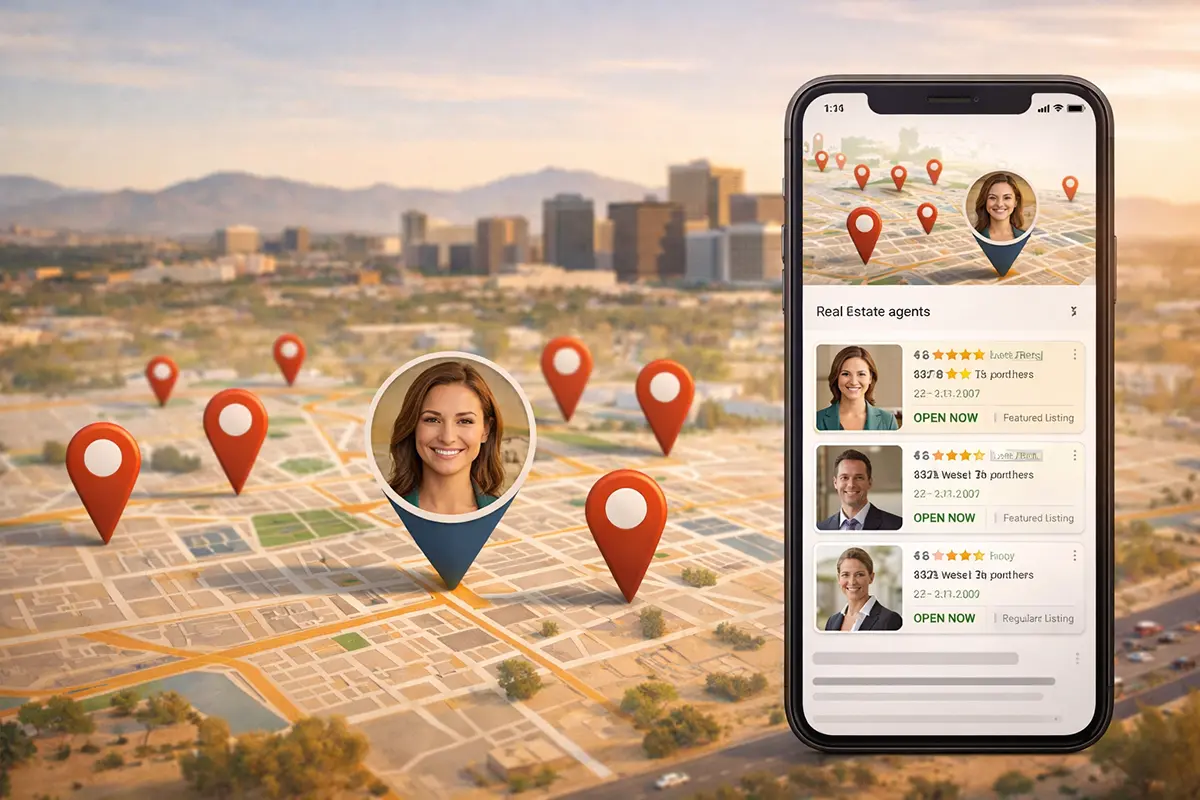
When people search for a real estate professional in Phoenix, Google often shows local map results before standard website listings. That means your Google Business Profile is frequently one of the first things a potential client sees, especially on mobile. For more detail, see Google’s own guide to how local search results work.
For brokerages, a strong office profile can help you compete for broad local-intent searches like “real estate agency Phoenix” or “real estate office near me.” For individual agents, a practitioner profile can help you appear for branded searches, neighborhood-focused searches, and name-based searches that a brokerage office page may not capture as effectively.
A complete profile also gives prospects more ways to evaluate you before they click. Photos, reviews, service descriptions, business hours, and updates all contribute to trust and conversion, especially in a category where the client is choosing a person as much as a company.
For many brokerages, a well-structured Google Business Profile is just one piece of a broader local SEO in Phoenix strategy that also includes on-site content, reviews, and neighborhood‑focused pages.
Brokerage vs. agent: who should have a profile?

A brokerage should typically have one Google Business Profile for each legitimate office location where it serves clients during stated business hours. That listing should use the brokerage’s real-world name, office address, phone number, and a matching website URL tied to the office or main site. Google’s local business guidelines emphasize that customer-facing businesses should be represented accurately and should not create misleading or duplicate profiles.
Individual agents can also qualify for their own listings. Google explicitly recognizes real estate agents as individual practitioners, which means an agent can have a separate profile when they operate as a public-facing professional serving their own clients.
In practice, that means the cleanest setup often looks like this:
This matters because Google does not want multiple listings that all represent the same business in slightly different forms. If every agent listing points to the same homepage, uses the same phone number, and looks nearly identical, it increases the chance of duplicate confusion.
For Phoenix real estate teams that operate as a sub-brand inside a larger brokerage, the GBP question becomes more nuanced — and the team’s own marketing infrastructure typically matters more than the GBP itself for closing attribution. We cover that in detail in our guide to Phoenix real estate teams.
Can multiple agents use the same brokerage address?
Yes, multiple agents can sometimes use the same brokerage office address, but only when the listings represent distinct practitioners rather than duplicate versions of the same business. Google’s guidance around practitioners and service businesses allows legitimate separate representation, but the profiles still need to be meaningfully differentiated.
That means a brokerage listing and an agent listing at the same address are not automatically a problem. The risk appears when the profiles share too many core signals, such as the same business name structure, same phone number, same website destination, and no clear distinction in branding or role. Duplicate-profile cleanup guidance consistently points to these matching core details as a major trigger for merges, suppression, or support issues.
If your brokerage has several agents in one office, use these rules:
Should agents use the brokerage office address or a home address?
This depends on how the agent actually operates.
If the agent regularly meets clients at the brokerage office, the office may be the cleaner public-facing address. If the agent works primarily from home and travels to clients, then a service-area setup is usually more appropriate. Google says businesses without a storefront with clear signage that serve customers at their locations should use a service-area profile rather than publicly displaying a home address.
For many Phoenix agents, that means:
Which website URL should an agent use?

In most cases, the best URL for an agent profile is a dedicated agent page or personal website, not the brokerage homepage. The reason is simple: Google needs clean signals, and users need a landing page that clearly matches the profile they clicked.
If a prospect clicks “Jane Smith, Realtor” in Google Maps and lands on a generic brokerage homepage with no obvious path to Jane’s information, that creates friction. A dedicated profile page creates better continuity, improves lead attribution, and helps distinguish the agent listing from the brokerage listing.
A strong agent landing page should include:
Treat that agent page as a mini home base and invest in landing page optimization so visitors immediately understand who you serve, why they should trust you, and how to contact you.
How to set up a compliant profile step by step

Use the real business name
Use the name the agent or brokerage uses in the real world. Do not add phrases like “best Phoenix Realtor” or “luxury homes expert” into the business name field. Google’s policies are very clear that business names should reflect real‑world branding, not keyword stuffing. You can review the full Google Business Profile guidelines for representing your business if you want to double‑check a specific naming or address scenario.
Choose the right category
For solo agents, “Real estate agent” is generally the most relevant primary category. For brokerages, “Real estate agency” is often the better primary category. Additional categories should only be added when they accurately describe the business.
Set the address or service area correctly
If the location is client-facing during business hours, use the physical office setup. If the business travels to clients and does not have a public storefront, use a service-area configuration and hide the address. Google’s service-area guidance is clear on this distinction.
Use consistent NAP details
NAP stands for name, address, and phone number. Those details should match your website and major citations as closely as possible because inconsistency makes your local footprint weaker and more confusing. Real estate-specific GBP guidance repeatedly emphasizes matching business data across platforms.
Complete the profile fully
Add services, description, hours, photos, appointment options, and updates. A complete profile gives Google more context and gives prospects more reasons to trust the business. Real estate GBP guides consistently recommend filling out every meaningful field and keeping the profile active over time.
Avoid duplicate creation
Before making a new listing, search Google and the Business Profile dashboard to confirm an existing profile does not already exist. Duplicate cleanup resources consistently warn that creating a second version of the same listing is one of the easiest ways to create ranking and support headaches later.
Best practices for Phoenix real estate profiles
If you want your GBP strategy to support real lead generation instead of just existing online, focus on these operational basics:
For Phoenix specifically, it also helps to reference the neighborhoods and communities you truly serve. That does not mean stuffing every city into your name or description. It means using natural, relevant local language on the landing page and inside the profile where appropriate.
If you want a reusable framework for this work, our Phoenix marketing toolkit walks owners and operators through the same local playbook we use for clients. We pair profile work with analytics and reporting setup so you can see which calls, forms, and messages actually came from local search.
Common mistakes to avoid
The most common real estate GBP mistakes are avoidable:
These mistakes usually do not fail all at once. More often, they create muddy signals, weaker conversions, and occasional support problems that are hard to untangle later.
Who this is for
This setup works best for:
For Phoenix teams that want their Google listings to support a larger Phoenix real estate marketing system, we package this work inside our Google Business Profile optimization service
This is not for:
FAQs
Should a Phoenix real estate team have its own Google Business Profile separate from the brokerage?
In most cases, no. Google’s policies favor practitioner profiles for individuals or office profiles for verified locations — teams typically don’t qualify as a separate entity unless they operate under their own DBA at a distinct address. The better strategy for Phoenix real estate teams is to invest in a team landing page, UTM-governed paid traffic, and CRM attribution, rather than fighting Google’s profile rules.
Can a Phoenix real estate agent have their own Google Business Profile if they work under a brokerage?
Yes. Google recognizes real estate agents as practitioners, so an individual agent can often have a separate profile when it accurately represents that person as a public-facing professional.
Can several agents use the same brokerage address?
Sometimes, yes. The key is whether they are distinct practitioner listings rather than duplicates of the same office business.
Should an agent use the brokerage homepage as their website URL?
Usually no. A dedicated agent page or personal site is typically better because it creates a clearer match between the profile and the landing page.
Should I show my home address on my Google Business Profile?
Only if it is a legitimate client-facing location. Otherwise, a service-area setup is usually the better choice.
What is the biggest local SEO risk with real estate Google Business Profiles?
The biggest recurring risk is duplicate or overlapping listings that blur the difference between the brokerage and the individual agent.
Need help cleaning up agent and brokerage Google Business Profiles?
If your Phoenix real estate agents and brokerage has overlapping listings, inconsistent contact info, or no clear local SEO structure, the fix is usually operational before it is tactical. Start with a clean profile strategy, clear landing pages, and proper tracking.
Request a Google Business Profile strategy call
Learn more about our Google Business Profile optimization service for Phoenix real estate before you book a call.