
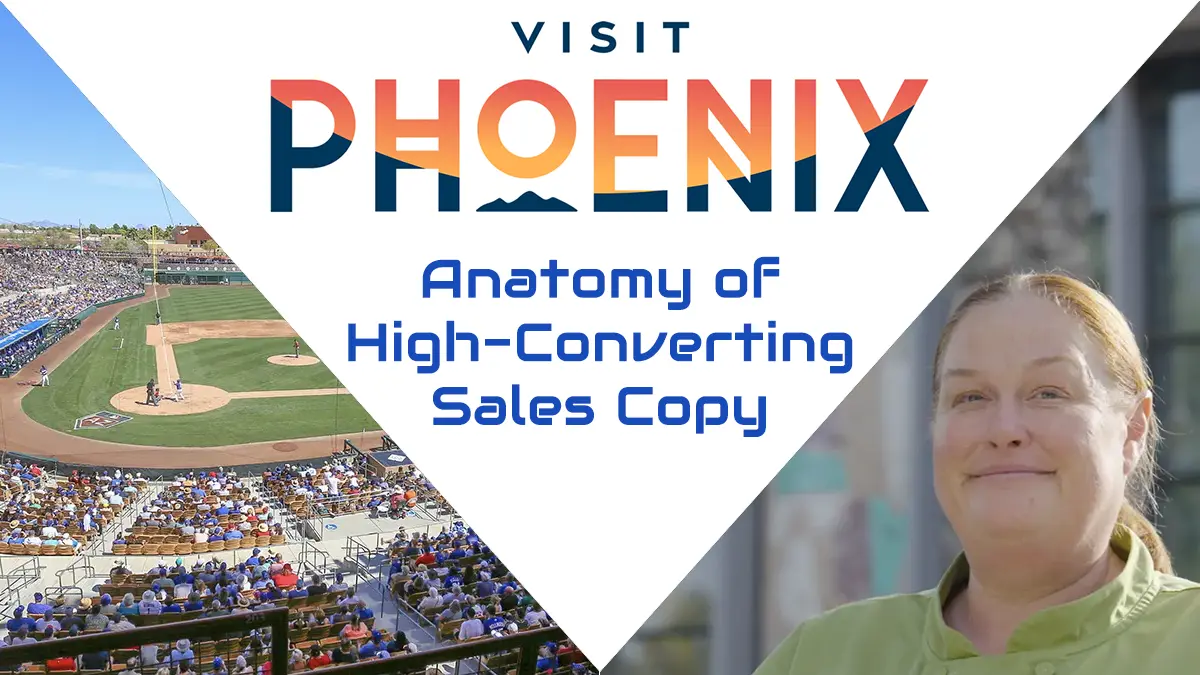
Every month, Biltmore Area Partnership (BAP) members share updates, stories, and offers for the online newsletter. This month, Visit Phoenix submitted a piece of sales-focused copy that shows what’s possible when strong storytelling is paired with clear calls to action and clean tracking.
Their March submission brought together two focused CTAs with full UTM tracking, a clear narrative, and links pointed at high-value landing pages on their site. My role was to match that intent on the BAP side with careful implementation and on-page SEO.
Why this Visit Phoenix submission works as sales copy
Effective sales copy answers three questions quickly: what’s happening, why it matters to me, and what I should do next. Visit Phoenix accomplished this in just a few lines.
- Timely hook: Spring Training season in Greater Phoenix, when 15 MLB teams play at 10 local ballparks across the region.
- Clear offers:
- A Cactus League apparel collection available online.
- A Sonoran Food Guide feature that spotlights Sphinx Dates and local culinary talent.
- Direct actions: Click to shop, or click to explore the story—both fully tracked.
Readers see two specific, relevant reasons to click, each supported by a strong image and a focused landing page.
Breaking down the structure
Here’s what the submission included and why it works:
- Headline built around the season
“Start the Spring Training Season Off Right” anchors the copy in a clear moment and promises a better way to experience it. The link goes straight to the Visit Phoenix store page featuring Spring Training and Cactus League merchandise, not a generic homepage. - Short, benefit-focused body copy
The apparel paragraph explains the collaboration with Cactus League, highlights Spring Training as a regional tradition, and invites readers to “commemorate your time in the Valley with a souvenir you can wear.” It balances emotion (memory, tradition) with practicality (shirts and hats in multiple styles for fans of all ages). - Second feature with depth and local flavor
The Sonoran Food Guide section shifts into culinary storytelling while staying rooted in place: a James Beard Award–winning chef, a locally grown Sphinx Date variety, Arcadia’s history, and the Sonoran Desert. This combination of authority and locality keeps readers engaged. - Supporting links that extend the journey
Links to Cactus League Spring Training, the Sonoran Desert overview, James Beard Awards coverage, Old Town Scottsdale, and the Arcadia neighborhood guide are woven into the copy. Each one gives readers a natural next click within Visit Phoenix’s ecosystem.
The quiet hero: UTM tracking on both CTAs
From a performance standpoint, a key strength of this submission is the way Visit Phoenix treated the links as campaign assets.
Both primary CTAs—the Spring Training store and the Sphinx Dates story—use UTM parameters that identify BAP as the source, email as the medium, and the specific March campaign in GA4. This allows their team to:
- See how much traffic the BAP newsletter drove.
- Measure clicks, time on page, and conversions from that traffic.
- Compare this placement to other channels using a consistent campaign naming convention.
For any organization investing in content and partnerships, that level of attribution turns visibility into measurable data.
What I added on the BAP side
On the BAP website, I focused on making sure the good work in the Visit Phoenix submission carried through into performance:
- Preserved tracking: Confirmed the UTM parameters stayed intact when the copy and links were added to the newsletter page, and verified the final URLs matched what Visit Phoenix provided.
- Strengthened on-page SEO: Set a descriptive title and meta description for the BAP newsletter entry, added alt text for both images, and kept Visit Phoenix anchor text descriptive so the page can contribute incremental SEO value over time.
- Aligned internal linking on the BAP site: Connected the newsletter into the broader BAP website structure so readers and search engines can move between this piece and related local business and tourism content.
The copy stayed exactly as Visit Phoenix submitted it; the implementation simply supports performance and measurement.
Takeaways for future BAP submissions
This Visit Phoenix entry offers a clear model other BAP contributors can use when they’re ready to turn a placement into a measurable mini-campaign:
- Lead with a timely, specific hook (season, event, launch, or milestone).
- Point the primary link to a focused, high-value landing page.
- Use UTM parameters so you can see what BAP-driven traffic does in GA4.
- Keep body copy concise, concrete, and centered on reader benefits.
- Pair the copy with imagery that reinforces the offer, like an in-game Spring Training photo or a chef in context.
Adopting even a few of these elements can make each submission work harder for the organization behind it.
Why this kind of example matters
Partners like Visit Phoenix are consistently creating strong stories that highlight Greater Phoenix, from Spring Training to Sonoran food culture. When those stories appear in BAP channels, thoughtful structure, tracking, and SEO help everyone—readers, member organizations, and the broader business community—get more value from each placement.
Camelback East Marketing focuses on that operator layer: turning good copy and creative into campaigns that can be implemented, QA’d, and measured. If you’d like support applying this approach to your own upcoming BAP submission or partner newsletter placement, that’s exactly where I can help.